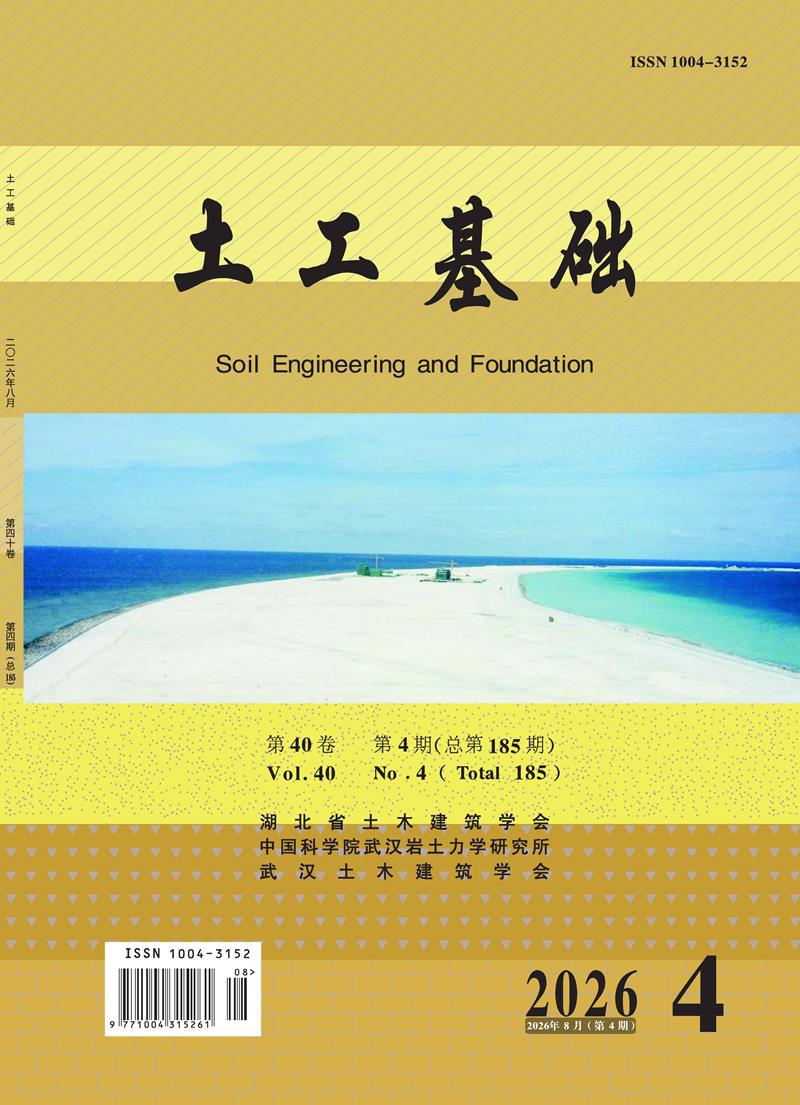
《土工基础》是湖北省土木建筑学会、中国科学院武汉岩土力学研究所、武汉土木建筑学会主办的学术期刊。本刊以刊载有关岩土工程实录、地质勘察技术、土工测试方法、土力学及岩石力学的基本理论、地基基础工程处理、各类型桩基以及岩土工程方面的新知识新成果新发现等方面的文章为主要内容。其中还将针对省市的城乡建设现代化、特别对沿江滨湖地区的沼泽沟塘的软土和一般填土用作地基基础问题的理论阐述并经验介绍。衷心希望由于本刊的出版,能够有助于提高土工基础科技水平,促进工业、民用建筑的建设速度快、质量优、消耗低、经济效果好,而裨益于国家建设。
31 December 2025, Volume 39 Issue 6 Previous Issue   
For Selected: Toggle Thumbnails
Application of Binary Composite Foundation in Liquefiable Soft Soil Site
YANG Bo, YANG BinBin, YANG Yang
2025, 39 (6):  811-814. 
Abstract ( 71 )  
To alleviate the pressure on the urban land caused by national economic developments, the construction industry has gradually developed towards the construction of highrise and super highrise buildings. China’s geological conditions are complicated, which requires a higher standard for the bearing capacity and the deformation of foundation soils. This paper presents a highrise building project of a liquefiable soft soil site in Chengdu area as a case history. A numerical model by using software Midas GTS NX to predict the postconstruction settlement deformation of building is established. After the completion of the project, comparing the load test and the settlement monitoring data of binary composite foundation, the measured data and the numerical simulation results are basically consistent, and the bearing capacity and deformation of foundation soils meet the requirements. The results show that in the field of sandy and silty liquefiable soft soils, the application of gravel columns, the Cement, Fly ash and Gravel (CFG) column composite foundation has remarkable effect on eliminating the liquefaction potential and improving the bearing capacity of foundation soils.
Related Articles | Metrics
Design and Application of Soldier Pile Supporting Structure for Deep Excavation in Complex Soft Soils
CAI Wenhua
2025, 39 (6):  815-820. 
Abstract ( 50 )  
The design and construction deep excavation supporting structure is a complex and comprehensive geotechnical engineering problem, the supporting structure design options and the final implementation are affected by many factors. The case history of a deep excavation in soft soils of Junlong Automobile Industrial Park project in Panyu District, Guangzhou is presented in this paper. The key aspects and difficulties in the deep excavation of this project are summarized. The selection of supporting design options in combination with the surrounding environment of the excavation, the excavation depth and the geotechnical conditions of the rock and soil strata, and the final design selection of the excavation support was determined as follows: sloping the side excavation, the use of cement mixed columns with insertion of steel sheet piles, steel pipe internal support, and reinforcement of the passive zone within the excavation. The measured displacements in the construction process are monitored and analyzed. The results prove that the deep excavation can be constructed safely and effectively, which can provide a valuable reference for the design and construction of the same type of soldier pile supporting structures.
Related Articles | Metrics
Case Studies on the Risk Source Engineering of a Subway Deep Excavation in Suzhou
CHEN Jingwei
2025, 39 (6):  821-826. 
Abstract ( 31 )  
With the rapid development of urbanization, many subway projects are being planned along subway lines. The construction dewatering and excavation of subway foundations will inevitably cause changes in the soil boundary conditions around the subway structure. The seismic performance of subway structures is also a key research subject. In order to study the impact of foundation excavation and dewatering on the surrounding environment and the seismic performance of the station structure itself, the risk sources of the station deep excavations, the environmental risk sources of the station excavations surroundings, and the characteristics of the station structure under seismic loads were analyzed by using the Qixing software, a 3D seepage analytical software Visual Modflow, and the finite element software Midas GTS NX. The analysis results indicates that the permeability of the soil is the main factor affecting the settlement of surrounding buildings and structures caused by dewatering inside the excavation. The settlement of surrounding buildings and structures is directly proportional to the radial distance from the excavation; The interlayer displacement between the middle plate and the bottom plate inside the subway station structure is greater than the interlayer displacement between the middle plate and the top plate.
Related Articles | Metrics
Optimization of Design Options for Deep Excavation Support in Complex Environments
ZHANG Cong, ZHOU Zheng, HUO Yulong,
2025, 39 (6):  827-831. 
Abstract ( 34 )  
With the rapid development of engineering construction, urban underground space excavation depth is gradually increased, and the surrounding environment is becoming increasingly complex. As a key part of the urban underground space engineering construction, deep excavation support design also faces different choices. Different excavation support design options have a significant impact on the safety, economy, and surrounding environment of foundation excavations The case history of the deep excavation of an underground precision laboratory in Wuhan, Hubei Province is presented in this paper. The paper starts from the theory of overall optimization and considering the surrounding buildings and environmental geotechnical conditions of the deep excavations. The applicability, safety, and economy of several excavation support design options are evaluated. Different excavation support design options are compared and selected. The excavation support design is optimized.
Related Articles | Metrics
Analysis of a Deep Excavation Adjacent to a River Supporting Design
LI Suchun, YUAN Yuntao, ZHANG Yongrui, WANG Tingting
2025, 39 (6):  832-836. 
Abstract ( 36 )  
The proposed rehabilitation engineering for Suzhou’s ancient wall was built along the river and affected by many factors. This case history analyzed the characteristics and difficulties of this project with the technical challenges of using the cement soil mixed columns and bored concrete piles. It was feasible to use the double-row steel sheet piles reinforced between rows. By using different software analysis and monitoring data, this paper analyzed the horizontal displacements of the pile heads. The effect of the eccentric pressure load was considered for the geotechnical design of the supporting structures. The front and rear rows of piles were better integrated and improved the deformation compatible by reinforcing between two rows. The same deformation was raised above the bottom of the excavations.
Related Articles | Metrics
Effect of MJS Strengthened Existing Station Structure on the Settlement of Adjacent Deep Excavation
LIN Mushuang, LAI Liang, LIU Yangfan, QIU Yuhua, HUANG Tianzhi, LIU Wei
2025, 39 (6):  837-845. 
Abstract ( 27 )  
The Metro Jet System (MJS) construction method has the advantages of larger column diameter, less disturbance to the surrounding environment and less construction pollution and can be applied in inclined, vertical and horizontal directions. During the construction of the transfer node of the Waitan Bridge Station of Line No. 7 of Ningbo Rail Transit, considering that the new building is close to the existing station in the complex surrounding environment of the soft soil stratum, the construction is likely to cause large deformation and excessive settlement of the project structure and surrounding structures, etc., so the MJS construction method is adopted to strengthen the structure. Throughout the data analysis of monitoring points during the construction, it is found that the soil has a general settlement trend, and the settlement changes faster in the early and later stages of construction. The monitoring points near or far from the excavation have less settlement and even bulge and the maximum appear at about 12m from the excavation. At different monitoring points along the same distance around the excavation, the overall change trend is similar. During the construction period, the maximum accumulated settlement of the excavation is 29.17mm, which meets the deformation control requirements.
Related Articles | Metrics
Deformation Mechanism and Treatment Measures of Rock Slopes
LIN Canyang
2025, 39 (6):  846-850. 
Abstract ( 34 )  
Rock slope deformation is subjected to the combinations of geologic structures, structural planes, and filling of structural planes. The geologic structure resulted in the development of structural planes, when weak planes (layers) and inclined planes developed, the slope deformation and the sliding may happen on the exposure face under the influences of those unfavorable factors. By analyzing the broken mechanism of rock slopes in the first place, then confirmed its deformation mainly resulted from the weak layer, the inclined plane, the continuous rainfall and the cutting vibration and so on. The stereographic projection analysis is performed to determine the slope deformation model and scale, finally, slope safety factors are analyzed according to its deformation status and provided targeted treatment measures.
Related Articles | Metrics
Impact River Channel Excavation Unloading on the Underlying Transit Structures
HUA Zhigang, CAO Yilong
2025, 39 (6):  851-855. 
Abstract ( 26 )  
In recent years, accidents that affect the existing rail transit structure or train safety have occurred frequently in the surrounding operations of urban rail transit. However, municipal engineering such as waterways inevitably intersects rail transit structures. How to implement effective technical measures to minimize the impact of construction on existing rail transit structures has become a research focus. The case history of the newly opened river channel above a shield tunnel of a rail transit line in Suzhou’s soft soil area is presented. This paper introduces a safety plan in the construction, the deformation control standards of the existing rail transit structures. The construction conditions are numerically simulated by establishing a three-dimensional numerical model. The measures of zoned displacement excavation, zoned excavation of soils in the river channel, load compensation for the excavation above the tunnel, and underwater excavation were taken for the riverbank revetment. Simulations were conducted by using MADIS (finite element analysis software), and the analysis results showed that adopting the above measures can minimize the impact of soil unloading on the rail transit. The deformation value of rail transit is less than the control standard value, The above technical solutions can provide reference for the design and construction of river engineering above shield tunnels in similar rail transit.
Related Articles | Metrics
Analysis of Influencing Factors of Dewatering in Deep Excavation with Suspended Cutoff Wall
NING Fangshuai, SHI Wenhao,
2025, 39 (6):  856-859. 
Abstract ( 28 )  
Compared with the bottom type of cutoff walls, the suspended cutoff wall is more prone to produce larger surface deformation outside the excavation after dewatering, so it has an important engineering significance for the research. The case history of a deep excavation project of Kunshan City Square is presented in this paper. A 3D dewatering model was established by using GMS MODFLOW to simulate the actual project dewatering conditions. The influence of dewatering rate, dewatering well layout and recharge rate on the dewatering effect was analyzed. The results show that the water level outside the excavation is basically in a stable state after 10 days of depth reduction, and the water level outside the excavation changes greatly on the first day of dewatering. Under the same total amount of dewatering, the layout of dewatering well has the same effect on the water level outside the excavation. The drop depth of water level outside the excavation increases with the insertion depth of filter pipe. The water level outside the excavation can be kept in a safe state by keeping the recharge and dewatering amounts above 70%.
Related Articles | Metrics
Design and Analysis of Super-Large Deep Excavation in Soft Soil and Complex Environment
CHENG Hong
2025, 39 (6):  860-865. 
Abstract ( 30 )  
The soft soil is characterized by high moisture content, low shear strength and high sensitivity. These characterizations make the foundation excavations prone to collapse and deform excessively, and therefore it poses significant safety hazards. Using a deep and large soft soil foundation pit project in Hangzhou as a case study, this paper examines the key issues and challenges in the design of supporting structures. The design solution is achieved through a sophisticated combination of bored pile/diaphragm wall + steel composite support + support replacement + servosystem. This design also considers the construction sequence, space-time effect, and combines with the surrounding environmental conditions and numerical simulation optimize the excavation division and internal support of the large deep excavations in soft soils. The active deformation control and design methods of deep excavations in large excavation depth and soft soils in sensitive environment based on space-time effect have been accomplished. The simulation results show that the maximum horizontal convergence displacement of the subway structure caused by the excavation is 5.2mm, and the maximum settlement is 5.8mm, which meets the deformation control requirements of the subway structure. The results provide valuable reference and guidance for similar engineering projects in the future.
Related Articles | Metrics
Key Technologies and Practices for Deep Excavation Support of Large-Diameter Pipe Groups Crossing the Utility Tunnels Using MJS Method
CAI Qing, HE Lihong, GAO Zengkui
2025, 39 (6):  866-872. 
Abstract ( 32 )  
Combined with the example of a deep excavation of a comprehensive utility tunnel, this paper introduces in detail the general conditions, surrounding environment, engineering geological and hydrogeological conditions of the foundation excavation at the intersection section of the utility tunnel and three existing pipelines. To ensure the stability of the soil on the side walls of the deep excavation and the safety of pipelines when the deep excavation of the utility tunnel crosses a large-diameter pipe group, the support measures of bored cast-in-place piles + internal supports + Metro Jet System (MJS) sidewall soil reinforcement + MJS bottom sealing are adopted for this section of the deep excavation. This paper systematically introduces the design ideas, design contents, construction process flows and construction requirements of the support options. The implementation of the project and the monitoring results show that by adopting this support plan, the safety of the deep excavation of the utility tunnel and the normal operation of the existing pipelines can be ensured, the technical problem that it is difficult to close the support structure when a large-diameter pipe group crosses the deep excavation of the utility tunnel can be solved. Compared with the option of rectangular pipe jacking crossing existing pipelines, the support plan shortens the construction period, saves costs and has good social and economic benefits.
Related Articles | Metrics
Application of Rotary Drilling with Pilot-Hole Piling in Complex Strata with Boulders and Its Pile-Forming Effectiveness
ZHANG Yipeng
2025, 39 (6):  873-878. 
Abstract ( 32 )  
This study focuses on a factory building project in Haicang District, Xiamen City. After comprehensively analyzing the applicability of traditional bored cast-in-place concrete piles and static press-in precast concrete pipe piles in the complex geological conditions characterized by soil strata with boulders and hard residual formations, a detailed geological survey was conducted by using advanced drilling techniques tailored to each pile location. Based on the findings, a combined pile foundation design and construction scheme integrating static press-in pile driving with rotary drilling pilot hole piling was proposed. This approach enabled the successful installation of UHC high-strength concrete pipe piles in the project. The effectiveness of the method was validated through static load tests and comparative tests using high-strain and low-strain dynamic testing methods. The results demonstrate that this technique provides a technically feasible, cost-effective, and quality-assured solution for pile foundation engineering in similar complex geological conditions.
Related Articles | Metrics
Geological Hazard Mechanism and Coupled Analysis of Greening and Maintenance of Landslides on the Xingye Section of the Foshan Qingyuan Conghua Expressway
XU Xiaodan
2025, 39 (6):  879-883. 
Abstract ( 30 )  
Expressways an important component of modern transportation systems. However, in their construction and later operation, slope or landslide issues become a safety critical factor that engineering and technical personnel tend to overlook, especially the coupling effect of slope greening and maintenance on landslide generation is rarely studied. The landslide on the Xingye section of the Foshan Qingyuan Conghua Expressway is presented in this paper. Throughout the on-site investigation and software analyses, the mechanism of landslide occurrence was analyzed, and a more reasonable mitigation design and greening maintenance plan were proposed. The safety factors, sliding force, anti-sliding force, anchor rod length, and grid beam reinforcement design analysis results of the landslide were compared with different literature methods. At the same time, the coupling between greening maintenance and landslide was analyzed in depth. The results indicate that (1) belongs to a typical small-scale soil landslide, and the occurrence of landslides is mainly influenced by a combination of factors such as slope morphology, mechanical properties of rock and soil mass, and meteorological and hydrological conditions; (2) The landslide safety factor, sliding force, and anti-sliding force analysis in the article, as well as the designed ground anchor length and grid beam reinforcement, are relatively close to the analysis results proposed in different literature, and have been well applied; (3) Slope greening and maintenance can effectively slow down rainwater runoff and reduce erosion of the slope surface, while root system stabilization can improve soil shear strength. The analysis results and design schemes can provide important references for highway slopes and ensure the safety of highway construction, which is of great significance.
Related Articles | Metrics
Structural Hazards Diagnosis and Deformation Characteristics of Shallow Embedded Subway Tunnels in Soft Soils
ZHANG Weifan, SU Chunxu
2025, 39 (6):  884-890. 
Abstract ( 28 )  
The structural hazards of active subway tunnels are important factors affecting the safe operation of subways. The hazards such as segmental total and differential settlements, cracking, dis-alignment, and water leakage are particularly prominent in subway tunnels. Reasonable and scientific diagnosis are prerequisite for the identification and mitigation of these hazards. The shallow embedded tunnel of the entrance and exit line of an urban rail transit line No.2 in the Pearl River Delta is presented in this paper as a case history. Through the analysis of engineering geological conditions, surface structural loads, external disturbance and other aspects, the geological radar detection, three-dimensional laser scanning and other methods were used to detect the current conditions of tunnel structural hazards, and combined with a variety of monitoring methods, the deformation characteristics of the tunnel structure were comprehensively evaluated. The results show that the settlement is the main factor of the current tunnel hazard. The current tunnel is in an unstable state of continuous development. Through the comprehensive evaluation and empirical judgment, the vehicle load of municipal road above the tunnel and the poor characteristics of soft soils are the main causes of the hazards. Combined with these, mitigation measures such as steel ring reinforcement in the tunnel, upper sheet pile bridging structure and compaction grouting are recommended. This case history can provide a reference for hazard control and safety assurance of subway tunnels in similar soft soils during operation.
Related Articles | Metrics
Stability of High Slopes and the Effectiveness of Support Schemes under Extreme Rainfall
JIA Jincheng
2025, 39 (6):  891-897. 
Abstract ( 19 )  
Based on the finite element method, a numerical simulation study on slope stability under extreme rainfall conditions was carried out with the focus on the influence of rainfall intensity and duration on the slope stability. The results indicate that the slope factor of safety decreases significantly with the increasing rainfall intensity and the prolonged duration. Under long-duration, high-intensity rainfall conditions, the slope is more prone to approaching a critical failure state. On this basis, the critical slip surface and factor of safety before and after rainfall infiltration are analyzed in combination with the response mechanism of pore water pressure within the slope under rainfall infiltration conditions. The reinforcement effect of a combined support system consisting of prestressed ground anchors and rock bolts is evaluated. The results show that this support scheme improves the stress state of the slope through the action of prestress, causing the critical slip surface to move deeper into the rock-soil mass. The research findings can provide a theoretical basis for optimizing support design of slope engineering under similar geological and meteorological conditions.
Related Articles | Metrics
Stability Analysis Method for the Foundation of Super-High-Rise Building on Rock
YIN Ji, WEI Jiaqi, LI Xiang, KONG Lingrong,
2025, 39 (6):  898-902. 
Abstract ( 23 )  
Based on the numerical analysis of a 380m super-high-rise building on the fractured bedrock, the strength reduction method, the load increasing method and the joint strength reduction method for the stability analysis of the foundation on the bedrock are proposed. One failure criterion is proposed based on multiple elastoplastic solvers and the tolerance of unbalanced force on the nodes, while another criterion based on the inclination of the foundation is also discussed. Based on the numerical model and results, for the super-high-rise building, the factor of safety controlled by the inclination of the foundation was smaller than that controlled by the tolerance of unbalanced force. For the fractured rock, the factor of safety calculated by the strength reduction method with Howk-Brown criteria was smaller than that calculated by the joint strength reduction method. The case in this paper may provide valuable experience for the stability analysis of the super-high-rise building on the rock.
Related Articles | Metrics
Numerical Simulation on the Influence of Deep Excavation in Soft Soils on the Deformation of Adjacent Buildings
YAN Guihai, GAO Yanlin, HU Junjie, HUANG Maolong, CHEN Yue
2025, 39 (6):  903-907. 
Abstract ( 24 )  
Using the background of the deep excavation of an expansion hospital in Xiangzhou District, Zhuhai City, a three-dimensional finite element analysis model that simultaneously considers the excavation and adjacent training building is established to comprehensively simulate the effects of the excavation and the dewatering in soft soil at each construction stage on the settlement of adjacent buildings. To validate of the modeling method and the accuracy of the numerical analysis, the numerical results of the settlement trend of the surrounding soils during the excavation process are compared with the actual field monitoring data. The results indicate that the deformation of the foundation of the adjacent training building structure meets the requirements but the settlement difference between the first floor of the training structure and the ground is relatively large, which is expected to have some impact on the use of the first-floor structure. This numerical simulation method can be applied to pre-analysis of other similar engineering projects, providing valuable references for the design and construction of deep excavation projects in soft soils.
Related Articles | Metrics
Deep Learning of Combined Predictions of Pile Ultimate Axial Capacity
ZHU Naijiang, LIANG Shichao, FAN Shiyuan, LIU Zhiqiang
2025, 39 (6):  908-912. 
Abstract ( 31 )  
To obtain a high-precision model for the axial capacity prediction of piles, in this paper, a combined prediction model based on the idea of combining prediction with the long-term and short-term memory neural network model (LSTM) and deep belief network model (DBN) is established. The combined model was further improved based on the Satin blue bowerbird optimization algorithm (SBO), Northern Eagle optimization algorithm (DGO) and Cuckoo optimization algorithm (CSA) to further improve the accuracy of the model. The results showed that: The Q-S curve of piles simulated by different models showed the same trend, and the fitting effect of SBO-DBN-LSTM model between the simulated and the measured values was the best. When the input parameters of the model were 5, the accuracy of the model was generally high; when the input parameters of the model are 4, although the accuracy is reduced, it can still meet the estimation requirements. The SBO-DBN-LSTM models can guarantee high accuracy under different input parameters and can be recommended for predicting the axial capacity of piles.
Related Articles | Metrics
Deformation Analysis of Soft Soil Filled with Foamed Lightweight Aggregate
CHEN Shao
2025, 39 (6):  913-917. 
Abstract ( 24 )  
To obtain the density parameters for the settlement of pavement over soft soils with the replacement of foamed lightweight aggregate, a finite element numerical model was established. The first-class highway reconstruction project of a national highway is presented in this paper to study the soft subgrade load reduction and replacement with foamed lightweight aggregate. The maximum settlement of the foamed lightweight aggregate with a density between 300 kg·m-3 and 700 kg·m-3 30 days after the replacement was also studied. The maximum settlement values of 30 days after pavement replacement under different densities of lightweight aggregates were 15.8mm, 23.1mm, 25.4mm, 32.3mm and 37.8mm, respectively. The positions of the observed maximum settlement were all at the center point of the roadbed; secondly, under the premise of considering quality and safety, it was determined that the lightweight aggregate density of 400 kg·m-3 was the most cost-effective product to meet the requirements of engineering construction. In addition, numerical analysis shows that under the same lightweight aggregate density, the post-construction settlement of the top of the pavement can be effectively reduced with the increase of the thickness of the foamed lightweight aggregate.
Related Articles | Metrics
Influence of Deep Excavation on the Stability of Adjacent High Voltage Transmission Tower
ZHANG Mingrui, LI Zhen, XU Qingwei
2025, 39 (6):  918-921. 
Abstract ( 26 )  
The deep foundation excavation would cause horizontal displacement and settlement of the adjacent high-voltage transmission line tower foundation. When designing deep excavation support systems, the deformation caused by excavation should be controlled within the allowable range. The excavation of a municipal pipe gallery foundation in Hefei is presented in this paper as an example. Three-dimensional finite element numerical simulation method was used to evaluate the deformation effect of deep excavation on the adjacent 220kV transmission line tower foundation. The deformation of the supporting structure and the tower foundation were obtained in the process of deep excavation. The numerical simulation results indicated that the closer the tower foundation was to the boundary of the excavation, the greater the horizontal displacement and settlement of the foundation. By comparing it with the monitoring data, it showed that the threedimensional finite element numerical simulation method was feasible to analyze the influence of deep excavation on the stability of the adjacent high-voltage transmission line tower foundation. It provided a scientific basis for determining a safe and reliable support system and could provide reference for similar projects.
Related Articles | Metrics
Correlation Analysis of Physical and Mechanical Indices of Silty Clay in Urban Area of Tai’an City
SU Chongfa, MENG Linghua
2025, 39 (6):  922-925. 
Abstract ( 18 )  
The physical and mechanical properties of silty clay in Tai’an city are presented in this paper. Based on a large number of geotechnical test data, the correlation analysis is performed, and a linear regression model is established. The linear regression equation between indicators is fitted, and the normal distribution of indicators is tested by skewness and kurtosis methods. The results show that the silty clay in the urban area of Tai’an City has low water content, small void ratio, mainly plastic state, medium compressibility soil, slightly high shear strength. The statistical dispersion of physical indicators is less than that of mechanical indicators; There is a positive correlation among void ratio, liquid index, compressibility coefficient and water content, void ratio and liquid index, liquid limit and plastic limit, plastic index and cohesion have a positive correlation, while liquid index and compression modulus have a significant negative correlation. Water content, liquid index and internal friction angle conform to normal distribution, void ratio, liquid limit, plastic limit and compressibility coefficient are approximately normal distribution, and other physical and mechanical indexes are non-normal distribution.
Related Articles | Metrics
Discrete Element Simulation of Stability of an Ancient Landslide in Shangnan
LIU Xiaowei, LUO Ruiqi, WU Bobo, MA Xiuru, FENG Jianxue,
2025, 39 (6):  926-930. 
Abstract ( 27 )  
An ancient landslide in Shangnan is studied in this paper. A twodimensional numerical model is established by using the discrete element method. The data of displacement, vector, monitoring point and measurement circle at different time are compared and analyzed. The results show that the strength of landslide rubble deposit and gravel layer is low, and the landslide slope is steep. The rubble deposit first slides from the toe of the slope, and the rear particles also slide downward to a certain extent due to the loss of the support of the front particles, so the entire rubble deposit slides. The gravel layer also partially slides under the drive of the gravel accumulation layer due to its low strength. The sliding zone appears at the interface between the gravel accumulation layer and the gravel layer, while the other three layers do not slide due to their high strength. Based on the above analysis, it is suggested that support measures should be taken for landslide to ensure the safety of engineering construction.
Related Articles | Metrics
Study on the Collapse and Failure Patterns of Roadbed Construction Based on the Material Point Method
JIN Xiaoming, LI Jianan, XU Hui, SUN Miaomiao, WANG Chengquan, LUO Haipeng
2025, 39 (6):  931-936. 
Abstract ( 24 )  
With the continuous advancement of urbanization construction, the hazard of road collapse in urban areas is becoming increasingly prominent, but the inherent mechanisms and evolutionary patterns are not yet clear. Taking the road collapse induced by underground engineering construction as an example, with a focus on the significant deformation and strain-softening characteristics during the collapse process, a numerical analysis method based on the Material Point Method (MPM) and the Drucker-Prager elastoplastic model was established. This method investigated the influence of different excavation conditions and stratum parameters on the deformation and failure modes of road collapse, as well as the underlying mechanisms. The results indicate that: (1) the proposed material point method numerical framework can effectively replicate the entire process of large deformation induced by shielded tunneling construction, providing an effective means for predicting hazards of similar nature; (2) the thickness of the overlying soil layer affects the shape and evolution of the shear band, thereby influencing the collapse characteristics-specifically, a thicker overlying soil layer results in a smaller degree of soil collapse, and when the subsidence on both sides is greater, the middle subsidence is smaller; (3) a smaller friction angle of the soil makes it easier for shielded tunneling construction disturbances to induce collapse, whereas in sites with greater soil cohesion, the degree of collapse induced by shielded tunneling construction disturbances is smaller.
Related Articles | Metrics
Analysis and Countermeasures of Creep Deformation and Failure Mechanism of a Steep Inclined Mudstone Interlayer Slope
ZHANG Ke
2025, 39 (6):  937-940. 
Abstract ( 18 )  
The excavation and unloading of steep and inclined rock slopes can cause stress redistribution on the slope, especially in areas of soft rock or weak joints, which can easily trigger creep deformation and ultimately lead to slope collapse. For steep slopes with unloading at the toe of the slope, creep tests, displacement monitoring, and engineering geological investigations were conducted on the soft and mudstone interlayers inside the slope to comprehensively analyze the deformation and failure mechanism of the slope. Research has shown that after unloading at the toe of the slope, the weak mudstone interlayer undergoes progressive creep slip under the driving load of the overlying rock layer. When the weak interlayer is saturated, it enters the accelerated creep stage, increasing the risk of sliding and collapse of the overlying rock mass. The results have played an effective guiding role in controlling the instability of the slope, and have also verified the correctness and effectiveness of the joints in this study. The results have good reference and guidance for similar projects.
Related Articles | Metrics
Method for Estimation of Axial Capacity of Rock Socketed Piles for Transmission Tower in Mountainous Areas
LI Qirui, ZHANG Yaosheng, LIU Zhirong
2025, 39 (6):  941-946. 
Abstract ( 19 )  
The axial capacity of rock socketed piles is obtained through static load test and code estimation methods. This paper summarizes the estimation formulas for rock socketed piles in various industry codes in China. The experience parameters that affect the accurate estimation and application of the formulas as well as the difference of these code methods are also analyzed in the paper. Then, the other research results are summarized, i.e., considering avoiding the use of empirical parameters and applying statistical analysis methods, obtaining empirical formulas for the limit side resistance and end bearing resistance. Finally, the research results of Lu Xianlong et al. are discussed, mainly focusing on the important parameter estimation formulas of the limit side resistance coefficient and end bearing resistance coefficient, which are compared and analyzed with the other results, showing that the estimated results are generally lower than the estimated values of the empirical formula obtained by previous research. The estimated results are generally conservative. Finally, the research results of Lu Xianlong et al. are discussed through an engineering case study with the accuracy and rationality of using their results to estimate the axial capacity of rock socketed piles in mountainous areas and unsuitable pile areas.
Related Articles | Metrics
Influence of Unloading on Axial Bearing Characteristic of Pipe Pile at the Bottom of a Foundation Excavation
ZHU Haofeng, CHEN Xiaowei, LIU Ting
2025, 39 (6):  947-954. 
Abstract ( 23 )  
The squeezing effect of the pipe pile at the bottom of the foundation is reduced by the excavation, which changes the axial capacity characteristic of the single pipe pile at the bottom of the excavation. Based on Vesic cavity expansion theory, considering the residual effect of the change of pressure at the bottom of the excavation, an estimation method for the jacking resistance is presented in this paper. Furthermore, based on the jacking resistance of pipe piles, an empirical formula for the axial ultimate capacity of the single pile is given. Moreover, the reliability of the empirical formula and the axial bearing influence factors of the pipe pile are studied in this paper. By comparing the estimation values of the resistance on the pile tip, the earth pressure on the pile side and the jacking resistance of the pipe pile with the measured values, the results show that the measured values of the resistance on the pile tip, the earth pressure on pile side and the jacking resistance of the pipe pile fit well with the calculated results, which verify the feasibility of the empirical formula. Based on Qu/Pu ratios by fitting method, the deviations between measured and estimation values are only 4.17% and 5.64% respectively, which also verify the feasibility of the empirical formula to the jacking resistance of a single pile. Moreover, it is found that the ratios of L/d and L/H have a significant effect on the earth pressure on the pipe pile, the jacking resistance, and the axial capacity of the single pipe pile. The smaller the ratios of L/d and L/H are, the greater the radial pressure of the pile, the more significant effect on the jacking resistance and the axial capacity of the single pile. The above conclusions can provide a theoretical basis for the design of the pipe pile at the bottom of the foundation excavation.
Related Articles | Metrics
Study on Pile Foundations in Karst Regions
LI Fuquan
2025, 39 (6):  955-959. 
Abstract ( 27 )  
More buildings are facing difficulties in pile foundation design and construction under karst geological conditions. The case history of a project in Hangzhou is presented in this paper. A systematic study was conducted on the design and construction methods of pile foundations in well-developed areas. Based on the specific situation of the project, the design parameters were optimized, and the pile foundation design scheme was compared and analyzed. The plan of using cast-in-place piles to pass through karst sections was selected, and the distribution of rock cavity was explored at each pile location. After comparison, the rotary pile driver was selected for the construction. After comparing and analyzing multiple pile foundation construction schemes, the principle of schedule and cost optimization was adopted to implement the pile concrete over pouring scheme. Targeted technical measures were taken to address specific issues such slurry borehole protection, construction safety of rotary pile drivers, concrete pouring, and steel reinforcement cage jamming during the pile foundation construction process. On the basis of ensuring project quality and safety, project schedule was accelerated, and the project cost was effectively reduced. The pile foundation QA testing results all met the design and specification requirements, which can provide guidance for similar projects.
Related Articles | Metrics
Prediction of Excavation Deformation of a Slope Based on PSOBP Neural Network
LI Kexi, LIANG Zhi, LI Wenfa, WAN Yi, LENG Xianlun,
2025, 39 (6):  960-964. 
Abstract ( 29 )  
An ultra-high excavated slope in Shenzhen has the characteristics of long excavation duration, complex construction process and variable climatic conditions, the prediction of slope deformation trend can provide a basis for the study of the overall stability of the slope. Combined with the design, geological data and on-site construction conditions, the orthogonal test method was used to sort out the database of geotechnical parameters and deformation trend of the excavated slope. Through the deep learning of the model, the geotechnical parameters of the slope are inverted, the elastic modulus is 115.6MPa, the cohesion is 28kPa, and the friction angle is 22°, and the finite element deformation analysis software is used to predict the deformation value of the next step excavation of the slope, and the relative error between the predicted deformation value and the actual monitoring deformation value is 6%~20%, indicating that the prediction model has high accuracy.
Related Articles | Metrics
Deformation Impact of Double Steel Pipe Jacking Through Medium-Coarse Sand Stratum Crossing High-Pressure Gas Pipeline
LIU Kai, QIU Huijun, CHEN Xuehua, WANG Zhihui, GAO Wei, LIANG Donghai, ZHOU Lihong
2025, 39 (6):  965-971. 
Abstract ( 30 )  
To study the influence of parallel jacking construction of double steel pipe jacking on adjacent high-pressure gas pipelines in medium-coarse sand strata, the Beijiang Water Diversion Project in Guangzhou is presented in this paper as a case history. The deformation pattern of gas pipelines during the crossing process of double pipe jacking is analyzed by using numerical simulation, theoretical calculation and field measurements. The main conclusions are as follows: (1) The interaction of double pipe jacking construction leads to significant superposition characteristics of pipeline displacement, and the maximum vertical displacement appears in the double penetration stage. (2) The lateral displacement of the pipeline caused by the construction of the double steel pipe jacking can be ignored; (3) The maximum settlement of the pipeline calculated based on the Peck correction formula is 3.29 mm, which is in good agreement with the numerical simulation value of 2.75 mm and the field measured value of 2.9 mm. All of them are less than the design allowable value of 10mm, which proves the reliability and practicability of the research method. The research results construct the theoretical analysis framework of pipe jacking interaction in sandy strata, and the proposed pipeline deformation prediction method can provide reference for similar projects.
Related Articles | Metrics
Classification and Prediction of Large Deformation of Tunnel Surrounding Rock Based on PGSA-RF#br#
HONG Jun
2025, 39 (6):  972-976. 
Abstract ( 26 )  
Large deformations of surrounding rock induced by tunnel excavation pose a common safety hazard in deep-buried soft rock tunnels, often leading to support structure failure, project delays, and even casualties. Traditional mechanical analysis methods rely on empirical assumptions and struggle to accurately predict deformation types and risk levels under complex geological conditions. This paper proposes an intelligent classification model based on a Plant Growth Simulation Algorithm-optimized Random Forest (PGSA-RF), which utilizes intelligent algorithms to globally optimize model parameters, significantly improving classification accuracy and efficiency. Validation results based on a global dataset of 130 tunnel engineering cases show that the PGSA-RF model achieves a classification accuracy of 91.2%, representing a 23.2 percentage point improvement over the baseline model, with superior stability and generalization capability. Feature importance analysis reveals that, within the scope of indicators collected in this study, the maximum horizontal stress, rock type, and integrity are the three dominant factors controlling the types of large deformations, providing a quantitative basis for on-site risk management. The model classifies individual cases in under 10 seconds, with a prediction error of no more than 8%, effectively addressing the prediction challenges of traditional methods under complex geological conditions. This offers a high-precision, high-efficiency intelligent analysis tool for risk assessment in geotechnical engineering.
Related Articles | Metrics
True Triaxial Test on Soft Soil Samples Improved by EICP Technique
SONG Xianjie, CAO Zhoujie, HUANG Danning
2025, 39 (6):  977-983. 
Abstract ( 59 )  
The soft soil in Shantou area was improved by enzymeinduced carbonate precipitation method. The test of the medium principal stress ratio b value is carried out on improved soil samples by the true triaxial test instrument. Under the same confining pressure and different b values, the deviatoric stress and pore water pressure of the improved soil samples increase with the increase of b value. Both the middle principal strain and the small principal strain of the reinforced soil change linearly. With the increase of b value, the absolute value of medium principal strain and small principal strain also increases correspondingly. Under the same b value and different confining pressure, the deviatoric stress and pore water pressure of the reinforced soil increase with the rise of the confining pressure. The medium principal strain and small principal strain of the reinforced soil increase with the increase of the confining pressure, and the deformation amount increases accordingly. The experimental results provide theoretical basis and experimental support for soft soil engineering in Shantou area.
Related Articles | Metrics
Study on Technology and Methods of Enlarging Column Tips for Cement-Soil Composite Columns
Zhang Junyu, FENG Aiguo, LIU Shuo, PENG Dianhua
2025, 39 (6):  984-986. 
Abstract ( 23 )  
To investigate the applicability of the technology and methods of enlarging column tips for cement-soil composite columns, a large-scale excavation and backfilling project in Fujian Province was selected as the research site. Two pipe piles with PHC 400 AB 600 specifications were chosen, and conventional column tips and enlarged column tips techniques were employed, respectively. Field static load tests were conducted to obtain the Q~s curves of the two columns. Strain gauges were installed at different sections to measure the axial force distribution along the column shaft, providing insights into the axial force distribution of the two columns. The results revealed that, under the same column top load, the settlement at the column tip was greater for the columns with enlarged tips compared to the piles with conventional pile tips. Furthermore, the technology of enlarging column tips effectively enhanced the mobilization of the end bearing resistance. Excavation of the soil around the columns after construction, coupled with the use of inclinometers, demonstrated that the adoption of enlarged column tips technology significantly improved the plumbness of the pile shaft.
Related Articles | Metrics
Construction Monitoring Design in a High-Risk Urban Tunnel Excavation
YANG Hongtao
2025, 39 (6):  987-992. 
Abstract ( 20 )  
The urban tunnel has the characteristics of highrisk, such as poor geological conditions, long construction period, large scale, and complex surrounding environment, as a result safety monitoring design aspects are proposed in this paper: Firstly, it is necessary to determine the adoption of technical basis by using the following aspects; focusing on the risk analysis of site geological conditions, construction method characteristics, and surrounding environmental conditions, sorting out potential engineering risk sources, dividing monitoring scope, determining monitoring levels and objects. Further, the determination of the monitoring items, monitoring frequency, etc. can be obtained. Secondly, based on the determined monitoring items, corresponding monitoring methods and technical means are selected or recommended to determine the accuracy of engineering monitoring. Finally, based on technical specifications or engineering experience, monitoring control values are therefore determined. The segmental tunnel between Lianban Station and Lianhua Intersection Station of Xiamen Metro Line 1 is presented in this paper as the case history. The design concept and analysis of safety monitoring are also introduced in detail.
Related Articles | Metrics
Construction Monitoring Analysis of Composite Steel Sheet Pile for Deep Excavation Support
MA Yulong, ZHU Mineng, HUANG Rui
2025, 39 (6):  993-997. 
Abstract ( 27 )  
The case history of deep excavation project of a school reconstruction and expansion project in Binjiang District, Hangzhou City is presented in this paper. The combined form of Larsen steel sheet pile and section steel (HUI) are used to support the foundation excavation, and the lateral displacement of the support structure are monitored. The adjacent surface settlement and the diagonal slant support axial force during the deep excavation are also monitored. Results show that, compared to single Larsen steel sheet piles or SMW construction methods, the composite steel sheet piles can better meet the deformation control requirements of support structures and effectively reduce the surrounding surface settlements during excavations. Based on its advantages of convenient construction and recyclability, this composite steel sheet pile can be suitable for the deep excavation support in soft soil with larger excavation depths. This case history has a good reference significance for similar projects in other soft soil areas.
Related Articles | Metrics
Experimental Study on Mechanical Strength of Red Mudstone Soft Rock by Using Rebound Wave Velocity Method
ZENG Xuesong, LUO Yangchujun, FENG Shiqing, CHEN Haoqi
2025, 39 (6):  998-1001. 
Abstract ( 22 )  
The mechanical strength of rock samples is a very important indicator in engineering practice, which can be used for the basic mechanical parameters of geotechnical engineering design and construction. Therefore, the ability to quickly and accurately obtain the compressive strength of rock samples is of great engineering significance for ensuring engineering quality, construction safety, and schedule. This study focuses on the red mudstone soft rock samples and proposes a rock strength testing method that combines rebound and wave velocity. A strength prediction model is established using binary nonlinear regression equations to achieve the goal of quickly, accurately, and non-destructive prediction of rock samples strength. Practice has shown that this rebound wave velocity test method is convenient for quickly, accurately, and conveniently obtaining the strength value of rock samples, improving the timeliness and economy of obtaining mechanical strength indicators in engineering construction projects, improving production efficiency, saving engineering costs, and providing new ideas and approaches for studying the mechanical properties of red mudstone soft rock samples and solving practical engineering problems.
Related Articles | Metrics
Mechanical Properties of Solidified Silt in Taihu Basin of Suzhou
WU Mingwei, YUAN Jinxing, LI Zuhui, LU Jinghui, WANG Yuexiang
2025, 39 (6):  1002-1007. 
Abstract ( 26 )  
Silty soils are widely distributed in delta areas in China. Due to its large void ratio, small bearing capacity and large deformation characteristics, engineering construction in these soils will likely induce safety and stability hazards. The solidified silty soil in the Taihu Basin of Suzhou is presented in this paper. The fly ash, mineral powder and lime were used as solidification materials to prepare the solidified silt soil samples. Throughout the compaction tests, unconfined compressive strength tests and rapid compression tests, the ratio of solidified material in soil samples was analyzed. and curing age on the compaction properties, unconfined compressive strength and compression properties of solidified silty soil samples, and the relationship between the engineering properties and influencing factors of solidified silty soil samples was obtained. The test results show that, the maximum dry density of the solidified silty soil samples decreases with the increase of the solidification material content, and the optimal moisture content shows the opposite trend; the unconfined compressive strength of the solidified silty soil samples increases with the solidification material content. As the value increases, the failure type tends to be brittle failure. The void ratio and compression coefficient of the solidified silty soil samples decrease with the increase in the amount of solidified material.
Related Articles | Metrics
Shear Strength Characteristics of Saturated Reticulated Red Clay Under the Action of Metal Ions
WANG Zhitao, LI Jianzhong, LIU Jiahe, YANG Rongyi, YIN Hongfei
2025, 39 (6):  1008-1013. 
Abstract ( 30 )  
Industrial wastewater contains various ions, which can affect the physical and mechanical properties of soils, but there is a lack of research on the relationship between the reticulated red clay and metal ions. To study the changing characteristics of the shear strength of the reticulated red clay under actions of metal ions, the saturated standard remodeled soil samples were prepared by adding metal ion solutions with different types and concentrations of ions, and then the changing curve of the shear strength by the consolidated undrained (CU) triaxial test was obtained. The microscopic tests such as XRD and XRF on soil samples after mechanical tests were performed to obtain changes in chemical elements and mineral composition. The test results showed that the change of cohesion of the reticulated red clay is related to the ion content in the undisturbed soil sample and the concentration of ions in solution of the immersed soil sample. The cohesion decreases with the increase of ion concentration, and the variation of internal friction angle is related to the valence state of metal ions. The curves of the cohesion and internal friction angle of the soil sample after the addition of Cu2+ have an inflection point when the ion concentration is 0.10 mol/L. The analysis of the triaxial test data shows that the inflection point is related to the change of the peak value of pore water pressure. Heavy metal ions enter the soil pores, change ion concentration of pore water and affect the changes in pore water pressure.
Related Articles | Metrics
Field Measurement of Water and Soil Pressures of Shielded Tunnels in Rock Mass
ZHAO Zhongyang, LIU Nianwu
2025, 39 (6):  1014-1018. 
Abstract ( 24 )  
The mechanical properties of rock and soil are relatively complicated, and it is necessary to study the analytical methods of soil pressures in shielded tunnels in this environment. Based on a section project of Taizhou Metro Line No. S1, the soil and water pressures during the entire process from tunnel excavation to soil stability were monitored throughout the in-situ tests. The magnitude and variation patterns of soil and water pressure values were analyzed. Results show that, due to the influence of grouting and temporary construction loads, the soil pressure changes significantly in the early stages of construction, showing a trend of first decreasing, then increasing, and then decreasing. The soil pressure of the two monitoring sections initially entered a stable period on the 5th day, and there was no significant fluctuation in soil pressure after 110-160 days. In the early stage of pipe construction, the water pressure rapidly increases and reaches its peak after one day. Subsequently, the water pressure gradually decreases and tends to stabilize. The change in soil pressure at different positions of the pipe segment is significantly greater than the change in water pressure. The results provide a reference basis for the design of shielded tunnels in similar rock environments, which helps to improve the quality of engineering construction.
Related Articles | Metrics
Statistical Analysis of Soft Soil Characteristics at Hengqin Section, Macau Light Rail and Its Engineering Measures
LI Xinpei
2025, 39 (6):  1019-1024. 
Abstract ( 26 )  
This study investigates the physical and mechanical properties of soft soil in the Hengqin Extension of the Macau Light Rail and its surrounding regions, along with corresponding engineering countermeasures. By analyzing data from 220 soft soil samples through physical and mechanical tests and regression analysis, the primary characteristics of the soft soil, such as high water content, strong compressibility, and low shear strength, were identified. The influence of these characteristics on foundation pit engineering was also examined. The results show that for saturated soft soil, the water content has a strong correlation with other physical property indexes, consolidation indexes and unconfined compressive strength, and a relatively strong correlation with plasticity indexes except the plastic limit, but a weak correlation with shear strength parameters. Based on the findings, targeted engineering measures, including a diaphragm wall with internal bracing systems, soil reinforcement, and dewatering schemes, were proposed to mitigate the adverse effects of soft soil on deep foundation pit construction. This research provides a valuable reference for integrating theory and practice in construction projects within similar soft soil regions.
Related Articles | Metrics
Field Study on Construction Parameter Optimization and Compaction Quality for Fine Sand Subgrades
WANG Junfei, HUANG Jun
2025, 39 (6):  1025-1030. 
Abstract ( 26 )  
The use of clay-wrapped fine sandy soil for highway subgrade slope filling is an innovative technique, but its compaction parameters and quality control standards remain to be clarified. To verify the feasibility of this technique and optimize the construction parameters, systematic compaction tests were conducted on a test section of a high-grade highway. Different compaction machinery combinations were employed for the operations, and the compaction quality was comprehensively evaluated using multi-index testing methods. The results show that: (1) The clay wrapping structure effectively maintains stable internal moisture within the sandy soil subgrade, verifying its engineering applicability. (2) Optimal compaction effectiveness for the fine sand filler is achieved with 6 passes of alternate longitudinal and transverse rolling using a bulldozer and a loose paving thickness of 35 cm. (3) Compared to the subgrade reaction modulus K30, the dynamic deformation modulus Evd demonstrates significant advantages in testing efficiency, data accuracy, and field adaptability, and is recommended as the core control indicator for the compaction quality of sandy soil subgrades. The research findings provide a scientific basis for construction quality control in similar projects.
Related Articles | Metrics